2014
|
Hoinkes, C.; Romano, M.; Ehrlich, I.; Höcherl, J.; Gebbeken, N. Investigation of fibre reinforced plastics with monolithic and hybrid stacking sequences under high-velocity impact loads. Leichtbau Proceedings Article In: Ziemann, O.; Mottok, J.; Pforr, J. (Hrsg.): Applied Research Conference 2014 – ARC 2014, Shaker-Verlag, 2014, ISBN: 978-3844028751. @inproceedings{Hoinkes2014,
title = {Investigation of fibre reinforced plastics with monolithic and hybrid stacking sequences under high-velocity impact loads.},
author = {C. Hoinkes and M. Romano and I. Ehrlich and J. Höcherl and N. Gebbeken},
editor = {O. Ziemann and J. Mottok and J. Pforr},
isbn = {978-3844028751},
year = {2014},
date = {2014-06-01},
booktitle = {Applied Research Conference 2014 – ARC 2014},
publisher = {Shaker-Verlag},
abstract = {This study deals with the experimental investigation concerning the energy dissipation capacity of reinforcement fibres in monolithic and hybrid layups, with and without a separating layer, under high-velocity impact loads. The investigated kinds of fibres are carbon, glass and basalt fabrics in a twill 2/2 construction. The test panels have been impregnated with the same thermoset resin. Curing was done by autoclave processing. The resulting fibre volume content of the test panels have been determined both analytically by weighting and experimentally by chemical extraction and calcination. The impact loadwas applied by accelarating bearing balls with weighted propellant in a sabot. The measured values are the velocities of the bearing balls as the impactor before and after the penetration of the test panels. The results show the energy sissipation capacity of each single kind of fibre in the monolithic layups as well as the enhanced properties of the hybrid stacked layups.},
keywords = {},
pubstate = {published},
tppubtype = {inproceedings}
}
This study deals with the experimental investigation concerning the energy dissipation capacity of reinforcement fibres in monolithic and hybrid layups, with and without a separating layer, under high-velocity impact loads. The investigated kinds of fibres are carbon, glass and basalt fabrics in a twill 2/2 construction. The test panels have been impregnated with the same thermoset resin. Curing was done by autoclave processing. The resulting fibre volume content of the test panels have been determined both analytically by weighting and experimentally by chemical extraction and calcination. The impact loadwas applied by accelarating bearing balls with weighted propellant in a sabot. The measured values are the velocities of the bearing balls as the impactor before and after the penetration of the test panels. The results show the energy sissipation capacity of each single kind of fibre in the monolithic layups as well as the enhanced properties of the hybrid stacked layups. |
Fritz, B.; Schmid, V.; Ehrlich, I. Analytical and numerical shear stress analysis of adhesive structural bonded joints under tension load. Leichtbau Proceedings Article In: Ziemann, O.; Mottok, J.; Pforr, J. (Hrsg.): Applied Research Conference 2014 – ARC 2014, S. 266–271, Ostbayerische Technische Hochschule Regensburg Shaker-Verlag, 2014, ISBN: 978-3844028751. @inproceedings{Fritz2014,
title = {Analytical and numerical shear stress analysis of adhesive structural bonded joints under tension load.},
author = {B. Fritz and V. Schmid and I. Ehrlich},
editor = {O. Ziemann and J. Mottok and J. Pforr},
isbn = {978-3844028751},
year = {2014},
date = {2014-06-01},
booktitle = {Applied Research Conference 2014 – ARC 2014},
pages = {266--271},
publisher = {Shaker-Verlag},
organization = {Ostbayerische Technische Hochschule Regensburg},
abstract = {Force transmission is a critical zone in the construction of technical components, especially if these contain parts of fibre-reinforced plastics. The aim of this research is to improve and enhance the force transmission for a structural tubular adhesive bonded joint under axial load. Therefore a finite element model is being developed to compare different analytical calculation approaches. First investigations are based on a geometric simple single lap joint with an adhesive layer of epoxy resin. This model is examined analytical for several different calculation approaches, especially Volkerson and Goland & Reissner. The analytical results are compared to finite element analysis, particulary for shear stress distribution and the shear stress concentration factor. As a next step, the experience for the single lap joint is transferred for the calculation of tubular adhesive lap joints. Just as like for single lap joints, analytical approaches (Pugno) are investigated and the results compared to finite element analysis. Special interest is attended to disagreements and simplifying assumptions analytic models have to assume. In these cases finite element analysis (FEA) can deliver results that correlate more precise in analysis for actual shear stresses. In this paper special focus is placed on the shear stress distribution over length and width of the adhesive layer and the influence of the shear-stress-concentration factor. Furthermore, other parameters (geometry, stiffness, material) that have influence on the stress distribution are analyzed and evaluated in future investigations.},
keywords = {},
pubstate = {published},
tppubtype = {inproceedings}
}
Force transmission is a critical zone in the construction of technical components, especially if these contain parts of fibre-reinforced plastics. The aim of this research is to improve and enhance the force transmission for a structural tubular adhesive bonded joint under axial load. Therefore a finite element model is being developed to compare different analytical calculation approaches. First investigations are based on a geometric simple single lap joint with an adhesive layer of epoxy resin. This model is examined analytical for several different calculation approaches, especially Volkerson and Goland & Reissner. The analytical results are compared to finite element analysis, particulary for shear stress distribution and the shear stress concentration factor. As a next step, the experience for the single lap joint is transferred for the calculation of tubular adhesive lap joints. Just as like for single lap joints, analytical approaches (Pugno) are investigated and the results compared to finite element analysis. Special interest is attended to disagreements and simplifying assumptions analytic models have to assume. In these cases finite element analysis (FEA) can deliver results that correlate more precise in analysis for actual shear stresses. In this paper special focus is placed on the shear stress distribution over length and width of the adhesive layer and the influence of the shear-stress-concentration factor. Furthermore, other parameters (geometry, stiffness, material) that have influence on the stress distribution are analyzed and evaluated in future investigations. |
Bruland, M.; Schmid, V.; Ehrlich, I. Analyzing and Testing of a Single Solution of Self-cutting Thread Inserts in Composites. Leichtbau Proceedings Article In: Ziemann, O.; Mottok, J.; Pforr, J. (Hrsg.): Applied Research Conference 2014 – ARC 2014, S. 286–288, Shaker-Verlag, 2014, ISBN: 978-3844028751. @inproceedings{Bruland2014,
title = {Analyzing and Testing of a Single Solution of Self-cutting Thread Inserts in Composites.},
author = {M. Bruland and V. Schmid and I. Ehrlich},
editor = {O. Ziemann and J. Mottok and J. Pforr},
isbn = {978-3844028751},
year = {2014},
date = {2014-06-01},
booktitle = {Applied Research Conference 2014 – ARC 2014},
pages = {286--288},
publisher = {Shaker-Verlag},
abstract = {This paper gives a summary of the analysis and the testing of a single solution of self-cutting thread inserts in semi-manufactured composites for shape cutting. The used composites and inserts are for commercial use. As composites are not designed for drilling and withstanding internal compressive stress, there are some challenges involved when attempting to place an insert. },
keywords = {},
pubstate = {published},
tppubtype = {inproceedings}
}
This paper gives a summary of the analysis and the testing of a single solution of self-cutting thread inserts in semi-manufactured composites for shape cutting. The used composites and inserts are for commercial use. As composites are not designed for drilling and withstanding internal compressive stress, there are some challenges involved when attempting to place an insert. |
Niedernhuber, M.; Ehrlich, I.; Holtmannspötter, J. Fiber-Oriented Repair of Fiber Reinforced Plastics: Investigations on Tensile Specimens Leichtbau Proceedings Article In: Ziemann, O.; Mottok, J.; Pforr, J. (Hrsg.): Applied Research Conference 2014 – ARC 2014, S. 298–302, Ostbayerische Technische Hochschule Regensburg Shaker-Verlag, 2014, ISBN: 978-3844028751. @inproceedings{Niedernhuber2014,
title = {Fiber-Oriented Repair of Fiber Reinforced Plastics: Investigations on Tensile Specimens},
author = {M. Niedernhuber and I. Ehrlich and J. Holtmannspötter},
editor = {O. Ziemann and J. Mottok and J. Pforr},
isbn = {978-3844028751},
year = {2014},
date = {2014-06-01},
booktitle = {Applied Research Conference 2014 – ARC 2014},
pages = {298--302},
publisher = {Shaker-Verlag},
organization = {Ostbayerische Technische Hochschule Regensburg},
abstract = {To minimize the repair area for fiber reinforced plastics (FRP), a new scarfing method is under investigation. For unidirectional plies, the idea is to perform a stepped scarf in fiber direction only. In theory, the repair area can be reduced up to 50 percent. Repair geometries generated with this method display varying overlap lengths in specific directions. With tensile tests of specimens according to german standards, a first comparison of mechanical values and joint strength between fiber-oriented scarfs and traditionally stepped scarfs in carbon fiber reinforced plastics (CFRP) was carried out. Mechanical values of the joint specimens showed only minor differences to intact laminates. The tensile strength of the stepped scarf and fiber-oriented scarf joints were around 50 % relative to the intact laminate. Our results show that the shorter overlap lengths in the plies of the fiber-oriented joints did not lead to the failure of specimen, instead, the butt joint on the outer surfaces of the specimens seem to be the initial point of failure.},
keywords = {},
pubstate = {published},
tppubtype = {inproceedings}
}
To minimize the repair area for fiber reinforced plastics (FRP), a new scarfing method is under investigation. For unidirectional plies, the idea is to perform a stepped scarf in fiber direction only. In theory, the repair area can be reduced up to 50 percent. Repair geometries generated with this method display varying overlap lengths in specific directions. With tensile tests of specimens according to german standards, a first comparison of mechanical values and joint strength between fiber-oriented scarfs and traditionally stepped scarfs in carbon fiber reinforced plastics (CFRP) was carried out. Mechanical values of the joint specimens showed only minor differences to intact laminates. The tensile strength of the stepped scarf and fiber-oriented scarf joints were around 50 % relative to the intact laminate. Our results show that the shorter overlap lengths in the plies of the fiber-oriented joints did not lead to the failure of specimen, instead, the butt joint on the outer surfaces of the specimens seem to be the initial point of failure. |
Gomez, D. Ibanez; Kastenmeier, A.; Ehrlich, I. Development and construction of a winding machine for the production of composite tubes. Leichtbau Proceedings Article In: Ziemann, O.; Mottok, J.; Pforr, J. (Hrsg.): Applied Research Conference 2014 – ARC 2014, S. 315–318, Ostbayerische Technische Hochschule Regensburg Shaker-Verlag, 2014, ISBN: 978-3844028751. @inproceedings{IbanezGomez2014,
title = {Development and construction of a winding machine for the production of composite tubes.},
author = {D. Ibanez Gomez and A. Kastenmeier and I. Ehrlich},
editor = {O. Ziemann and J. Mottok and J. Pforr},
isbn = {978-3844028751},
year = {2014},
date = {2014-06-01},
booktitle = {Applied Research Conference 2014 – ARC 2014},
pages = {315--318},
publisher = {Shaker-Verlag},
organization = {Ostbayerische Technische Hochschule Regensburg},
abstract = {The project is about the development and construction of a filament winding machine. The aim of the project is that the laboratory of composite technology of the Ostbayerische Technische Hochschule Regensburg is able to produce composite tube specimens in laboratory scale, so that different tube geometries can be manufactured. With a own machine the lab is able to produce many different specimens. Furthermore, the lab is able to test in additional machines different force transmissions or respectively connections of the tubes with metal flanges. Presently there is no possibility for the lab to produce tube specimens. In fact the winding technology already exists on the market, but for the lab it is important to have a machine with the right properties. For example the functions of the machine must be adjusted to the specifications of the tube specimens. The machine is constructed of four modules: a pre-load-, an impregnation-, a slide- and a mandrel-module. The function of the pre-load module is to aplly a defined load to the rovings. In the impregnation module the rovings are wetted with resin. The combination of the slide- and mandrel-module enables the define depositting of the rovings on the mandrel. The VDI guideline 2221 is used to develop the winding machine. In this guideline the approach of the development is defined. The first step is to define the requirements. After that a theoretical solution has to be found and this solution has to be elaborated. Finally, the concept has to be optimized for the assembly.},
keywords = {},
pubstate = {published},
tppubtype = {inproceedings}
}
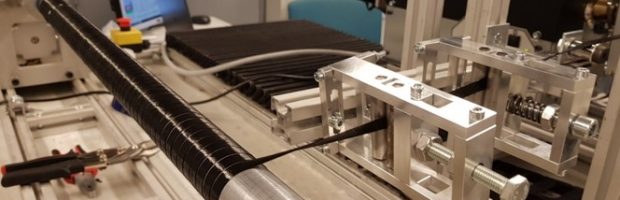
The project is about the development and construction of a filament winding machine. The aim of the project is that the laboratory of composite technology of the Ostbayerische Technische Hochschule Regensburg is able to produce composite tube specimens in laboratory scale, so that different tube geometries can be manufactured. With a own machine the lab is able to produce many different specimens. Furthermore, the lab is able to test in additional machines different force transmissions or respectively connections of the tubes with metal flanges. Presently there is no possibility for the lab to produce tube specimens. In fact the winding technology already exists on the market, but for the lab it is important to have a machine with the right properties. For example the functions of the machine must be adjusted to the specifications of the tube specimens. The machine is constructed of four modules: a pre-load-, an impregnation-, a slide- and a mandrel-module. The function of the pre-load module is to aplly a defined load to the rovings. In the impregnation module the rovings are wetted with resin. The combination of the slide- and mandrel-module enables the define depositting of the rovings on the mandrel. The VDI guideline 2221 is used to develop the winding machine. In this guideline the approach of the development is defined. The first step is to define the requirements. After that a theoretical solution has to be found and this solution has to be elaborated. Finally, the concept has to be optimized for the assembly. |